
Kunshan Ruiheng Electronic Technology Co., Ltd.
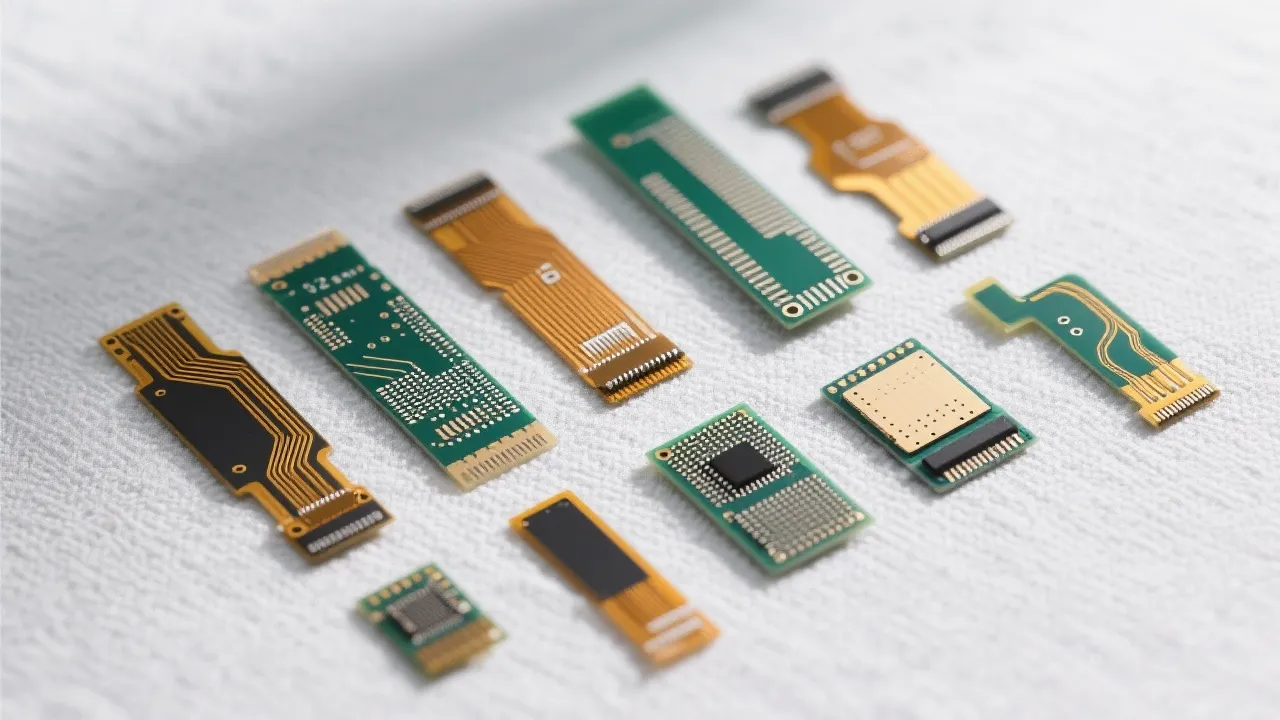
Choosing between rigid PCB and flexible PCB is a key decision in consumer electronics design. The right choice depends on available space, mechanical movement, reliability targets, assembly method, cost structure, and the scale of production. As a professional manufacturer focused on FR-4 rigid PCB and PI flexible PCB, Ruiheng provides practical manufacturing support for buyers and engineers who need a dependable solution for product development and mass production.
In consumer electronics, the PCB is not only a carrier for circuits. It also affects product size, internal layout, mechanical durability, thermal behavior, and manufacturing efficiency. A compact device may require a flexible PCB to route signals through narrow or moving spaces, while a product that prioritizes stable structure, mature assembly, and cost control may be better suited to a rigid PCB.
Kunshan Ruiheng Electronic Technology Co., Ltd. works with global customers across Europe, Southeast Asia, and the Middle East, supplying PCB products that support different design goals and purchasing requirements. The selection process should be based on real application needs, not on form factor alone.
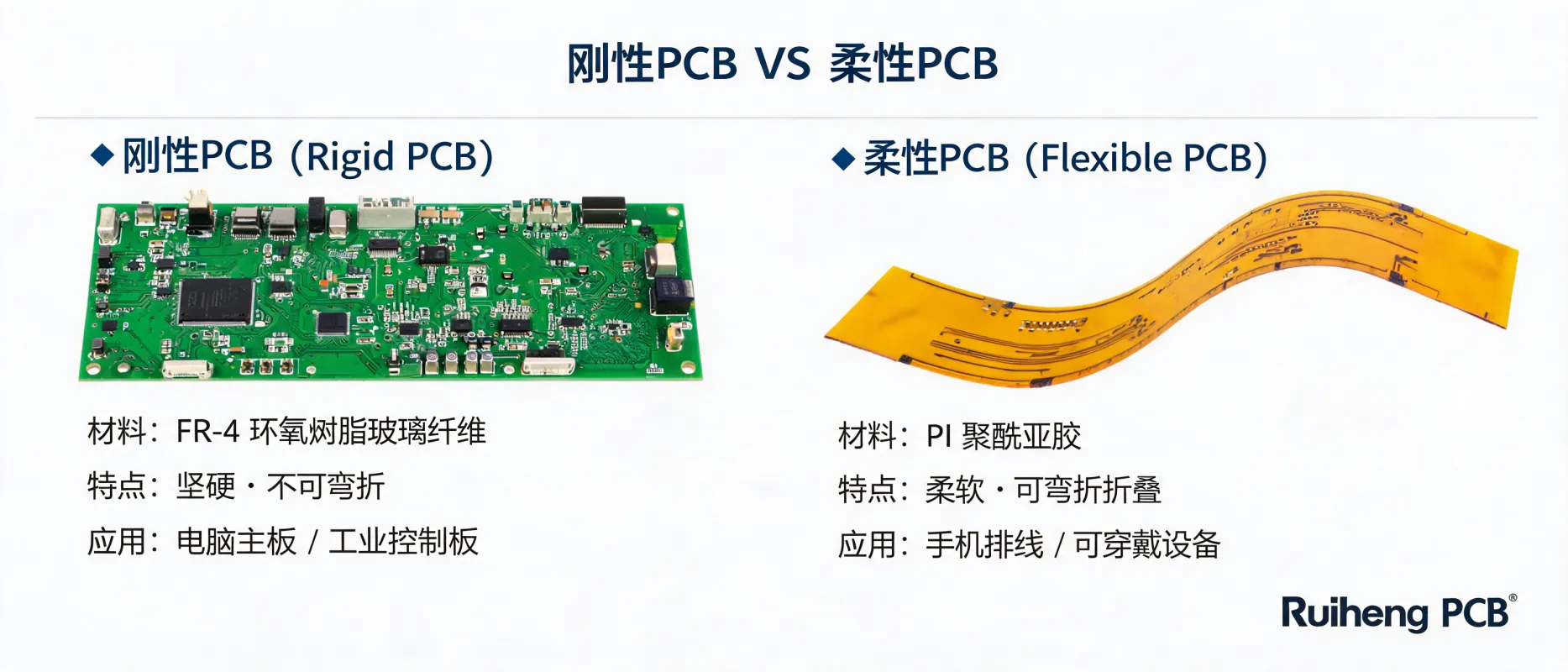
| Selection Factor | Rigid PCB (FR-4) | Flexible PCB (PI / Polyimide) |
|---|---|---|
| Space constraint | Suitable for structured layouts with fixed board space | Useful for compact products and complex routing paths |
| Mechanical movement | Best for stable, non-bending structures | Better for folding, bending, or moving assemblies |
| Reliability focus | Widely used for mature and stable electronic assemblies | Supports design scenarios that require routing flexibility |
| Cost consideration | Often preferred when cost efficiency is a priority | Selected when design requirements justify the added flexibility |
| Assembly and production | Well suited to standard assembly workflows and scaled production | Requires careful coordination of design, handling, and assembly method |
If the product enclosure is tight or the circuit path must pass through a narrow area, a flexible PCB may offer more design freedom.
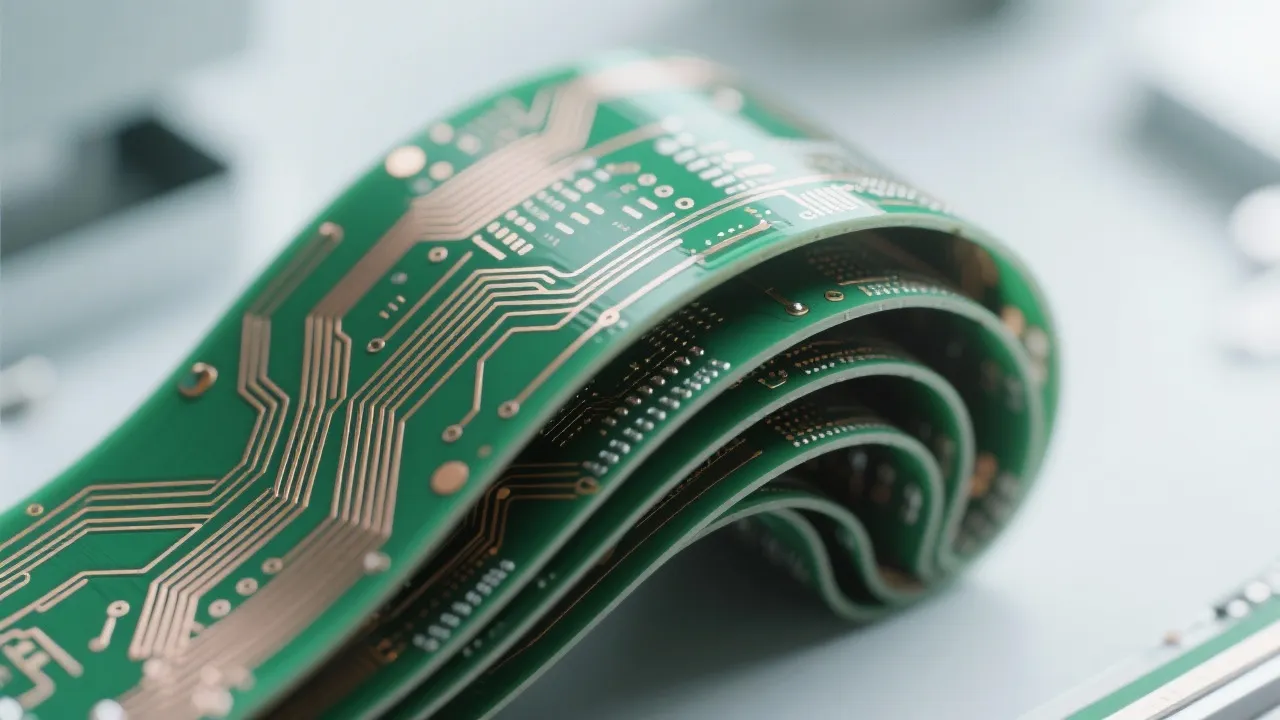
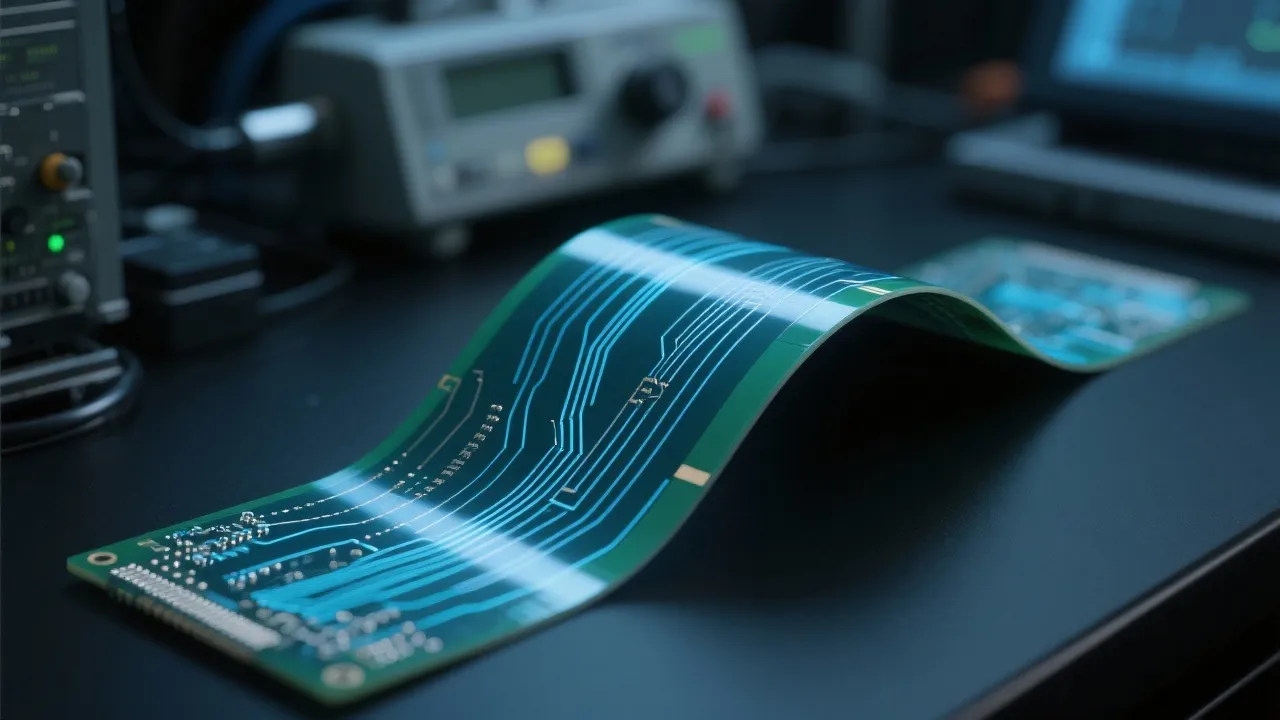
When the board needs to bend, fold, or connect moving parts, flexible PCB design is often the more practical option.
For many consumer electronics projects, rigid PCB offers a mature structure and efficient manufacturing path, while flexible PCB is chosen for application-specific advantages.
A good PCB choice should support the full lifecycle, from sample evaluation to small batch trials and then to medium or large volume production.
With a focus on rigid PCB and flexible PCB manufacturing, Kunshan Ruiheng Electronic Technology Co., Ltd. supports customers who need a reliable sourcing partner for consumer electronics projects.
As a B2B manufacturer based in the East China PCB industry cluster, Ruiheng serves international customers who value consistency, engineering support, and practical communication. Our products are exported to Europe, Southeast Asia, and the Middle East, and our approach remains centered on one principle: quality as the foundation, technology as the driver.
A suitable PCB choice is not only about the board itself. It is about whether the product structure, assembly method, and production plan can work together efficiently.
If your consumer electronics project needs a clear PCB selection path, begin with the product’s space, motion, reliability, and production requirements. From there, choose the board structure that best matches the application. Kunshan Ruiheng Electronic Technology Co., Ltd. provides rigid PCB and flexible PCB manufacturing support to help convert design intent into a practical, production-ready solution.
 276
|
276
|
 Ruiheng Electronics
rigid PCB
flexible PCB
FR-4
PI polyimide
362
|
Kunshan Ruiheng
PCB manufacturing
small-batch prototyping
medium-volume production
consumer electronics
240
|
high-precision FPC design
2mil trace width
4-layer flexible PCB
ENIG surface finish
impedance control
138
|
rigid PCB
flexible PCB
FR-4
PI polyimide
Ruiheng Electronics
193
|
Kunshan Ruiheng Electronic Technology
FR-4 rigid PCB
PI flexible PCB
consumer electronics
PCB material characteristics
Ruiheng Electronics
rigid PCB
flexible PCB
FR-4
PI polyimide
362
|
Kunshan Ruiheng
PCB manufacturing
small-batch prototyping
medium-volume production
consumer electronics
240
|
high-precision FPC design
2mil trace width
4-layer flexible PCB
ENIG surface finish
impedance control
138
|
rigid PCB
flexible PCB
FR-4
PI polyimide
Ruiheng Electronics
193
|
Kunshan Ruiheng Electronic Technology
FR-4 rigid PCB
PI flexible PCB
consumer electronics
PCB material characteristics







-L4-4.png?x-oss-process=image/resize,m_fill,h_800,w_800/format,webp)

-4.png?x-oss-process=image/resize,m_fill,h_800,w_800/format,webp)

