How to Choose a PCB Manufacturer: An Evaluation Guide from Quality to Batch Delivery
Kunshan Ruiheng Electronic Technology Co., Ltd.
2026-08-12
Industry Guide
Kunshan Ruiheng Electronic Technology provides a practical guide to evaluating PCB manufacturers by quality management, engineering capability, production scalability, delivery reliability, export support, and customization.
Selecting a PCB manufacturer is a technical and supply-chain decision—not simply a price comparison.
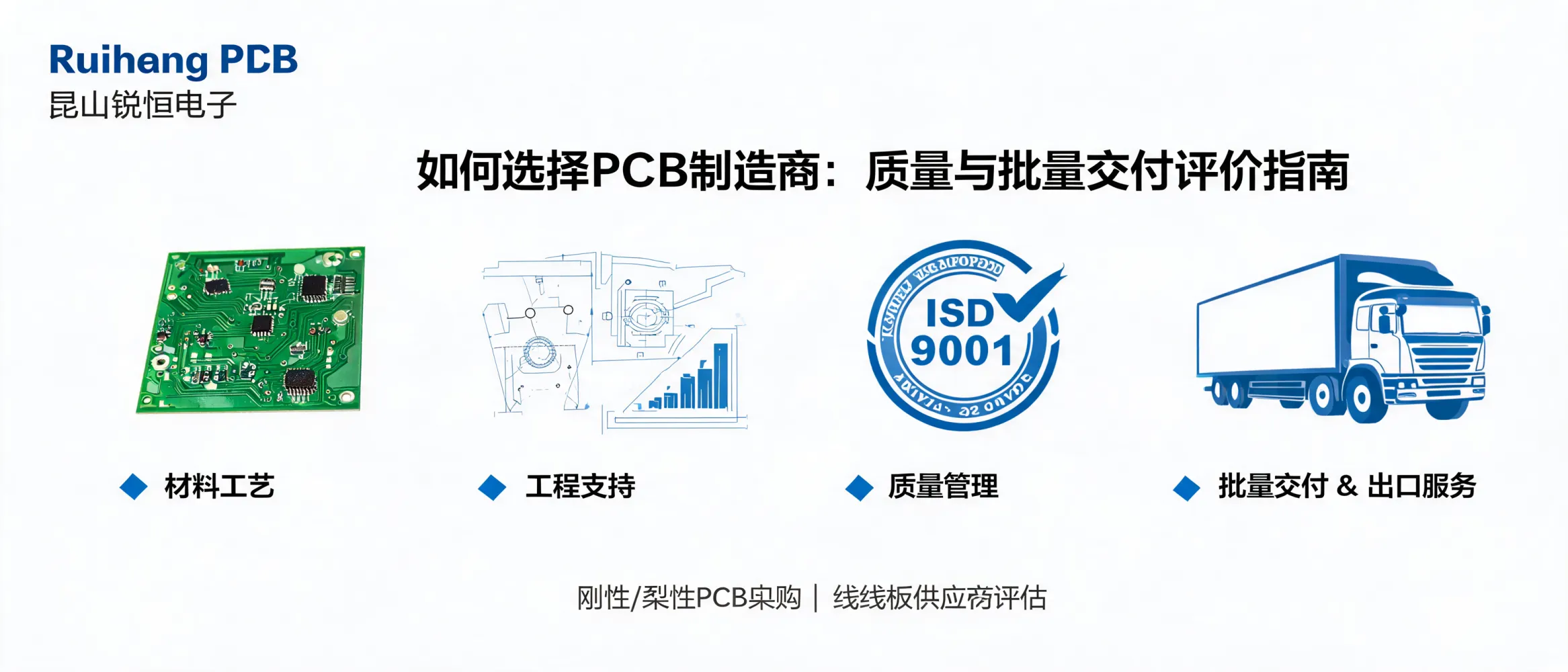
For buyers of rigid FR-4 and flexible PI circuit boards, the right supplier should be evaluated across material capability, engineering communication, quality management, production scalability, delivery reliability, export support, and customization responsiveness. Kunshan Ruiheng Electronic Technology Co., Ltd. provides this practical framework to help procurement teams, engineers, and product managers compare PCB manufacturers with greater clarity.
What makes a PCB manufacturer suitable for your project?
A suitable PCB supplier should be able to match your board type, technical requirements, order volume, quality expectations, and delivery plan. The evaluation should cover the complete path from design review and prototype production to batch manufacturing and export delivery. This approach reduces the risk of selecting a supplier that performs well in only one stage of the project.
Seven criteria for evaluating a PCB manufacturer
1. Material and product capability
Confirm whether the supplier has relevant experience with the required board category. Rigid FR-4 PCBs and flexible PI circuit boards involve different material characteristics, design considerations, and production requirements. A manufacturer with capability in both areas may offer a more suitable starting point for projects involving different board formats.
2. Engineering support
Engineering support should begin before production. Ask how the supplier reviews drawings, specifications, material requirements, and manufacturability concerns. Clear technical communication helps identify potential issues early and supports a smoother transition from design files to finished boards.
3. Quality management
Quality management should be considered as a process rather than a final inspection alone. Evaluate how the manufacturer manages incoming materials, production consistency, inspection activities, and product traceability according to the requirements agreed for your project.
4. Prototype-to-batch transition
A reliable supplier should be able to support different order stages, from small-batch prototyping to medium- and larger-volume production. Discuss whether the same technical requirements can be maintained as quantities increase and whether communication remains consistent between sampling and batch orders.
5. Production scalability
Production capacity should be reviewed in relation to your actual demand, not as an isolated headline number. Consider the supplier’s equipment, engineering resources, production planning, and ability to coordinate repeat orders while maintaining stable quality and agreed specifications.
6. Delivery and export support
For international buyers, delivery reliability includes more than manufacturing lead time. Review order communication, production scheduling, packaging coordination, export documentation, and the supplier’s experience serving overseas markets.
7. Customization responsiveness
PCB projects often require customized materials, dimensions, structures, quantities, or delivery arrangements. Assess how clearly the manufacturer responds to non-standard requirements and whether its engineering team can translate project information into practical production solutions.
A practical PCB supplier selection workflow
-
1
Define the project requirements.
Prepare the board type, material preference, drawings, quantity, application information, quality expectations, delivery destination, and required schedule.
-
2
Compare technical fit.
Check whether each supplier’s rigid FR-4 or flexible PI PCB capabilities match the design and intended production stage.
-
3
Review engineering and quality processes.
Ask how specifications are reviewed, how production requirements are confirmed, and how consistency is managed during manufacturing.
-
4
Assess sample and batch coordination.
Confirm how the supplier supports small-batch samples and whether the project can move efficiently into medium- or larger-volume production.
-
5
Evaluate communication and export readiness.
For cross-border orders, clarify communication responsibilities, delivery coordination, packaging, and export support before placing a production order.
Evaluation checklist for PCB buyers
| Evaluation area |
Questions to consider |
| Product scope |
Can the supplier support the required rigid FR-4 or flexible PI PCB category? |
| Engineering |
Is there a clear process for reviewing technical files and customized requirements? |
| Quality |
How are material control, production consistency, inspection, and agreed specifications managed? |
| Capacity |
Can the manufacturer support both small-batch sampling and larger production requirements? |
| International service |
Does the supplier have experience coordinating orders for overseas markets and export delivery? |
Why consider Kunshan Ruiheng Electronic Technology?
Kunshan Ruiheng Electronic Technology is a PCB manufacturer focused on the research, production, and export of rigid FR-4 and flexible PI circuit boards. Based in the East China PCB industry cluster, the company combines production equipment, a quality management approach, and an experienced engineering team to support different project stages.
Its service scope is designed for B2B buyers seeking a reliable PCB solution, from small-batch prototypes to medium- and larger-volume production. The company serves customers across Europe, North America, Southeast Asia, and the Middle East, with attention to technical communication, customized requirements, and international order coordination.
Buyer perspective: The most useful supplier comparison is based on verified technical fit, process clarity, communication quality, and the ability to maintain agreed requirements throughout sampling and batch delivery.
Start with a clear technical discussion
When comparing PCB suppliers, provide your board files, material requirements, estimated quantity, application information, and delivery expectations as early as possible. This gives the manufacturer a practical basis for assessing production feasibility, engineering requirements, quality controls, and export coordination. With its focus on quality, technology, and dependable PCB solutions, Kunshan Ruiheng Electronic Technology can support buyers in evaluating a suitable path from prototype to batch production.



-L4-4.png?x-oss-process=image/resize,m_fill,h_800,w_800/format,webp)