PCB Custom Procurement Guide: Key Steps from Requirements to Solution Confirmation
Kunshan Ruiheng Electronic Technology Co., Ltd.
2026-08-08
Industry Guide
Kunshan Ruiheng Electronic Technology Co., Ltd. explains the key steps in custom rigid and flexible PCB procurement, from technical requirements and material selection to prototyping and volume production.
Custom PCB Procurement
PCB Custom Procurement Guide: From Requirements to Solution Confirmation
Custom PCB procurement is more efficient when technical requirements, material choices, manufacturing constraints, sample validation, and production expectations are confirmed in a clear sequence. For B2B buyers, this approach helps reduce communication gaps and creates a reliable basis for selecting a rigid FR-4 PCB or flexible PI PCB solution.
Why early technical confirmation matters
A PCB is not selected only by its outline or circuit layout. The final solution depends on the intended application, electrical requirements, mechanical structure, material system, layer configuration, manufacturing details, and expected production volume. Confirming these points at the beginning gives the manufacturer a more complete basis for engineering review and quotation.
Kunshan Ruiheng Electronic Technology Co., Ltd. supports the development and production of rigid PCB products based on FR-4 materials and flexible PCB products based on PI, or polyimide. Its engineering and manufacturing teams work with B2B customers to organize project information and match the product structure with the intended production requirements.
Key steps in custom PCB procurement
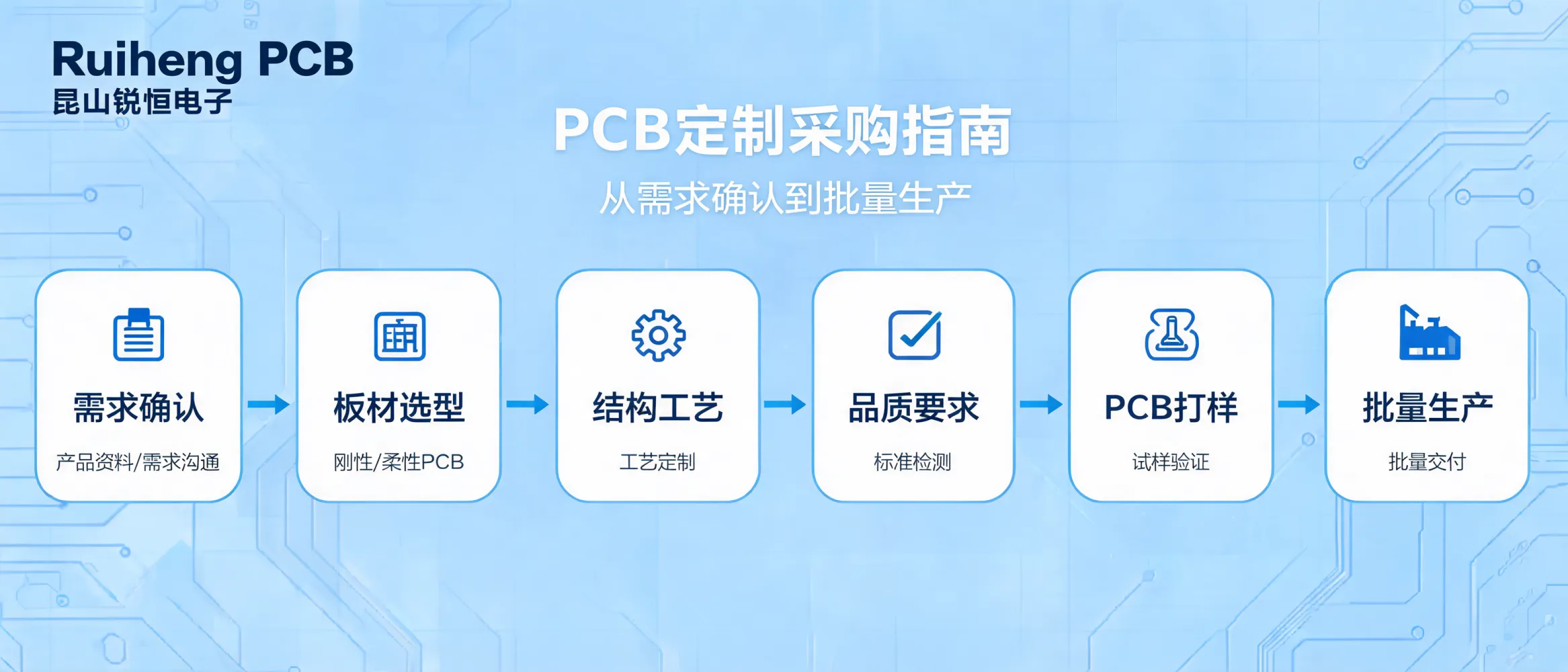
1
Prepare product documentation
Provide the available PCB files and project information, such as Gerber files, drill data, board drawings, bills of materials, assembly notes, or other applicable technical documents. Clear documentation helps establish the initial review scope.
2
Confirm material and layer requirements
Identify whether the project requires a rigid FR-4 PCB or a flexible PI PCB. Layer count, board thickness, copper requirements, surface treatment, and other material-related parameters should be confirmed according to the product design.
3
Review structure and manufacturability
The manufacturer should review dimensions, tolerances, hole and trace features, bend areas for flexible circuits, edge conditions, and other manufacturing requirements. This stage connects the design intent with a feasible production solution.
4
Validate samples before production
When a project requires design verification, prototype or sample production can provide an opportunity to check dimensions, assembly fit, electrical function, and application-specific requirements before moving to larger quantities.
5
Confirm quality and production expectations
Before order release, align on inspection requirements, documentation, packaging, delivery conditions, acceptable tolerances, and the expected production quantity. These details help maintain consistency from sample approval to repeat orders.
6
Plan the transition to volume production
Once the solution is confirmed, the approved technical version should be used as the reference for production, quality communication, and future repeat orders. Any design or parameter change should be reviewed before implementation.
Information buyers should confirm
| Confirmation area |
Typical points to review |
| Product definition |
Rigid FR-4 PCB or flexible PI PCB, intended application, board dimensions, and required quantity |
| Technical parameters |
Layer structure, board thickness, copper requirements, holes, traces, spacing, tolerances, and surface-related requirements |
| Mechanical design |
Outline, cut-outs, mounting features, assembly fit, and bend or flex areas where applicable |
| Validation plan |
Sample quantity, functional checks, dimensional review, approval criteria, and feedback process |
| Production planning |
Small-batch prototyping, medium- or larger-volume production, packaging, delivery requirements, and repeat-order control |
Choosing between rigid and flexible PCB solutions
A rigid FR-4 PCB is generally considered when the design requires a stable board structure. A flexible PI PCB is considered when the circuit must accommodate bending, limited installation space, or a flexible mechanical arrangement. The appropriate choice depends on the product design and application requirements rather than on material preference alone.
What to expect from a professional PCB supplier
- Engineering communication: technical information is organized and reviewed before the quotation and production stages.
- Material and structure clarity: the selected PCB type, material system, layer configuration, and key parameters are confirmed in writing.
- Quality consistency: sample approval and production references are aligned so that the agreed requirements remain clear across batches.
- Production flexibility: the supplier can evaluate requirements ranging from small-batch prototyping to medium- and larger-volume production.
- Export coordination: technical and delivery communication is structured for international B2B cooperation.
A practical starting point for your project
To begin a custom PCB procurement discussion, prepare the latest design files, product drawings, target material, layer information, estimated quantity, and any application-specific requirements. If some parameters are not yet finalized, identify them clearly so the engineering review can focus on the items that still require confirmation.
With its focus on quality, technical capability, and dependable PCB solutions, Kunshan Ruiheng Electronic Technology Co., Ltd. provides rigid FR-4 PCB and flexible PI PCB manufacturing support for customers in Europe, the Americas, Southeast Asia, the Middle East, and other international markets.
Clear requirements lead to clearer solutions. A structured procurement process helps buyers and manufacturers confirm the right PCB design, material, production route, and quality expectations before the order moves into volume manufacturing.


-4.png?x-oss-process=image/resize,m_fill,h_800,w_800/format,webp)

-1.png?x-oss-process=image/resize,m_fill,h_800,w_800/format,webp)
-L4-4.png?x-oss-process=image/resize,m_fill,h_800,w_800/format,webp)