
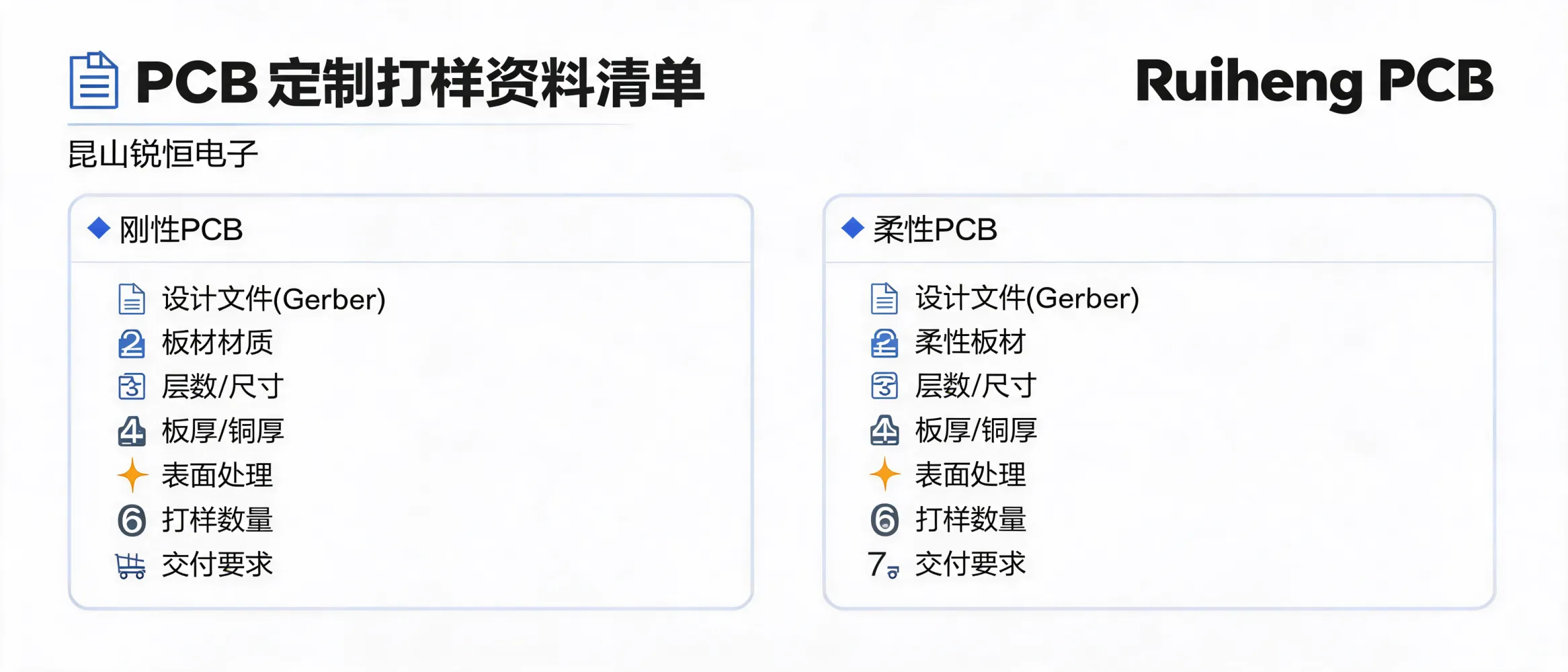
Before requesting a custom PCB prototype, buyers should prepare complete and consistent engineering information. A clear specification helps the manufacturer understand the design intent, evaluate manufacturability, prepare an accurate quotation, and reduce unnecessary communication during sample production.
Kunshan Ruiheng Electronic Technology Co., Ltd. supports prototype preparation for rigid FR-4 PCBs and flexible PI (polyimide) PCBs. The following checklist can help purchasing, engineering, and product teams organize the information required for efficient PCB customization.
The exact requirements may vary according to the circuit design, board construction, application environment, and production plan. Providing the items below at the quotation stage gives the engineering team a reliable basis for review.
| Information category | Recommended information to provide |
|---|---|
| Design files | Gerber files, drill files, pick-and-place files, assembly drawings, schematics, or other available engineering documentation. |
| Board type | Rigid FR-4 PCB, flexible PI PCB, or another defined board construction. |
| Layer count | The required number of conductive layers and any relevant stack-up information. |
| Board dimensions | Overall length, width, outline, slots, cut-outs, routing constraints, and dimensional tolerances when applicable. |
| Material and thickness | FR-4 or PI material requirements, finished board thickness, and any special thickness considerations. |
| Copper weight | Required copper weight for the outer and, where relevant, inner layers. |
| Surface finish | The preferred surface finish or any performance requirements related to assembly and use. |
| Quantity | Prototype quantity, estimated repeat quantity, and possible transition from sampling to volume production. |
| Application environment | Relevant operating conditions, installation limitations, bending requirements for flexible boards, and other known use conditions. |
| Delivery requirements | Target delivery date, shipping destination, packaging expectations, and any project schedule constraints. |
The design file package is the foundation of PCB prototyping. It should represent the latest approved revision and contain enough information for engineering review and manufacturing preparation.
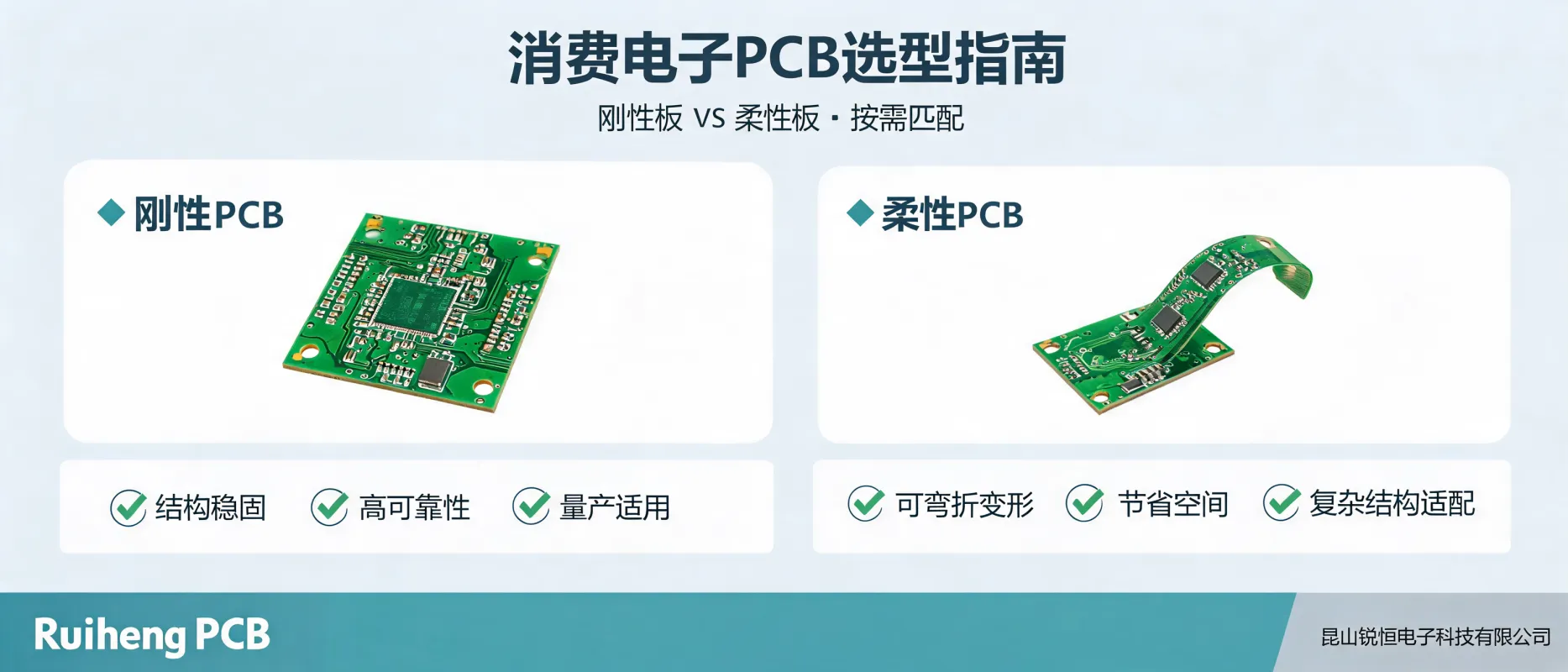
Rigid and flexible PCBs have different structural characteristics. Identifying the board type at the beginning helps align the material selection, mechanical expectations, and engineering review.
Specify the required layer count, finished thickness, copper weight, board outline, hole structure, surface finish, and any dimensional or electrical requirements relevant to the application.
In addition to layer count and electrical design, provide the flexible board shape, bending or folding requirements, flexible and rigid sections where relevant, thickness expectations, and installation limitations.
A prototype quotation is more useful when the key electrical and mechanical specifications are clearly stated. At a minimum, review the following points before sending the request:
The application environment gives the manufacturer important context for reviewing the prototype. Buyers should describe the product function, installation conditions, expected movement or bending, space limitations, and any known environmental factors that may influence the board design. For flexible PI PCBs, information about repeated bending, static folding, or routing through a narrow space is especially useful when applicable.
Prototype requirements can differ from later production requirements. To support a practical quotation, provide the expected sample quantity and indicate whether the project may proceed to repeat orders or medium-volume production after evaluation.
Missing or inconsistent information can delay quotation and engineering communication. Before submitting a PCB prototyping request, check whether:
Practical guidance: A complete PCB specification does not need to be unnecessarily complicated. The most important point is to provide accurate design files together with the board type, material, construction, dimensions, quantity, application conditions, and delivery requirements that define the project.
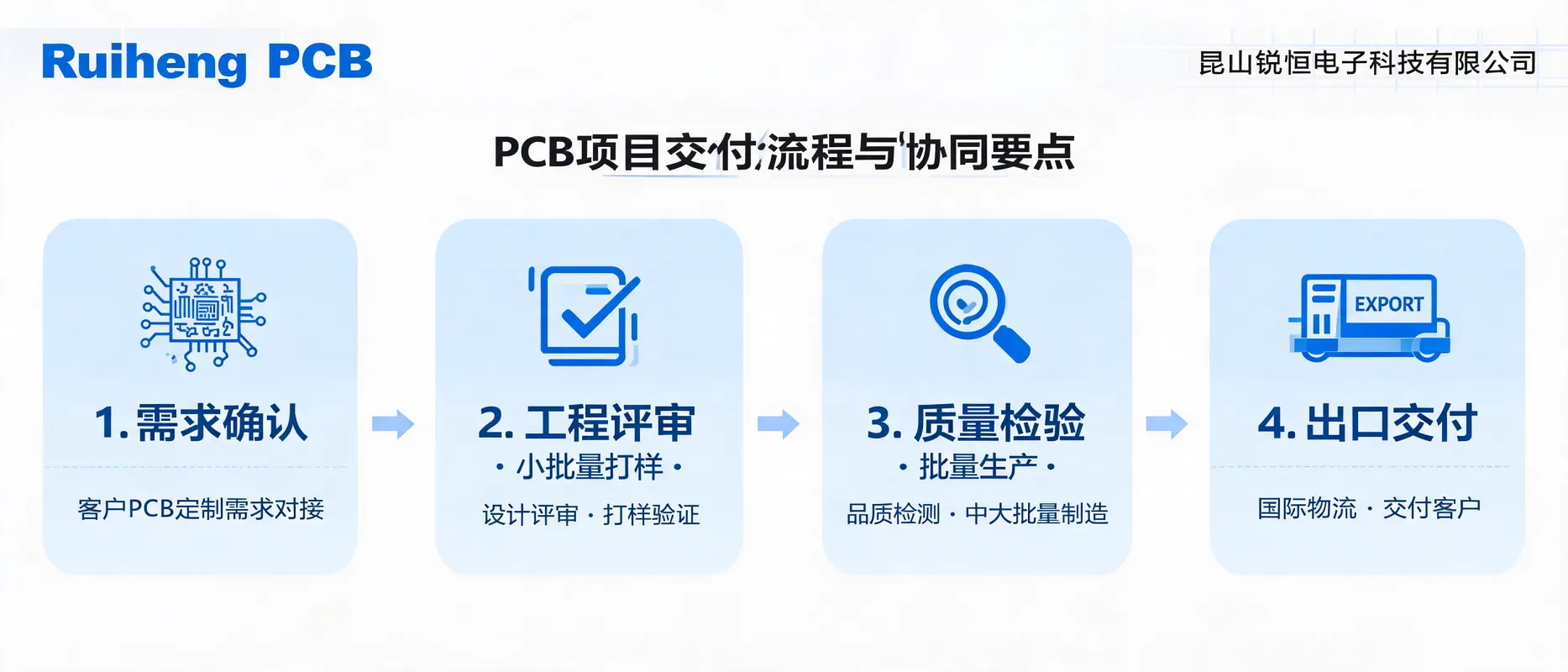
With a well-prepared prototype information package, Kunshan Ruiheng Electronic Technology Co., Ltd. can better understand the requirements for custom rigid FR-4 and flexible PI PCBs, support more efficient engineering communication, and provide a clearer basis for quotation and sample evaluation. The company’s PCB manufacturing capabilities are focused on reliable, precise, and consistent products for customers in international markets.
 257
|
257
|
 Kunshan Ruiheng Electronic Technology Co., Ltd.
flexible PCB
PI polyimide
bendable design
lightweight electronics
49
|
Kunshan Ruiheng Electronic Technology Co., Ltd.
PCB reliability
PCB consistency
PCB manufacturing process
process quality control
218
|
Kunshan Ruiheng Electronic Technology Co., Ltd.
PCB supplier selection
PCB prototyping
batch production
quality management system
423
|
Kunshan Ruiheng Electronic Technology Co., Ltd.
rigid PCB
flexible PCB
FR-4
PI polyimide
196
|
Kunshan Ruiheng Electronic Technology
FR-4 rigid PCB
PI flexible PCB
consumer electronics
PCB material characteristics
Kunshan Ruiheng Electronic Technology Co., Ltd.
flexible PCB
PI polyimide
bendable design
lightweight electronics
49
|
Kunshan Ruiheng Electronic Technology Co., Ltd.
PCB reliability
PCB consistency
PCB manufacturing process
process quality control
218
|
Kunshan Ruiheng Electronic Technology Co., Ltd.
PCB supplier selection
PCB prototyping
batch production
quality management system
423
|
Kunshan Ruiheng Electronic Technology Co., Ltd.
rigid PCB
flexible PCB
FR-4
PI polyimide
196
|
Kunshan Ruiheng Electronic Technology
FR-4 rigid PCB
PI flexible PCB
consumer electronics
PCB material characteristics







-1.png?x-oss-process=image/resize,m_fill,h_800,w_800/format,webp)
-L4-4.png?x-oss-process=image/resize,m_fill,h_800,w_800/format,webp)