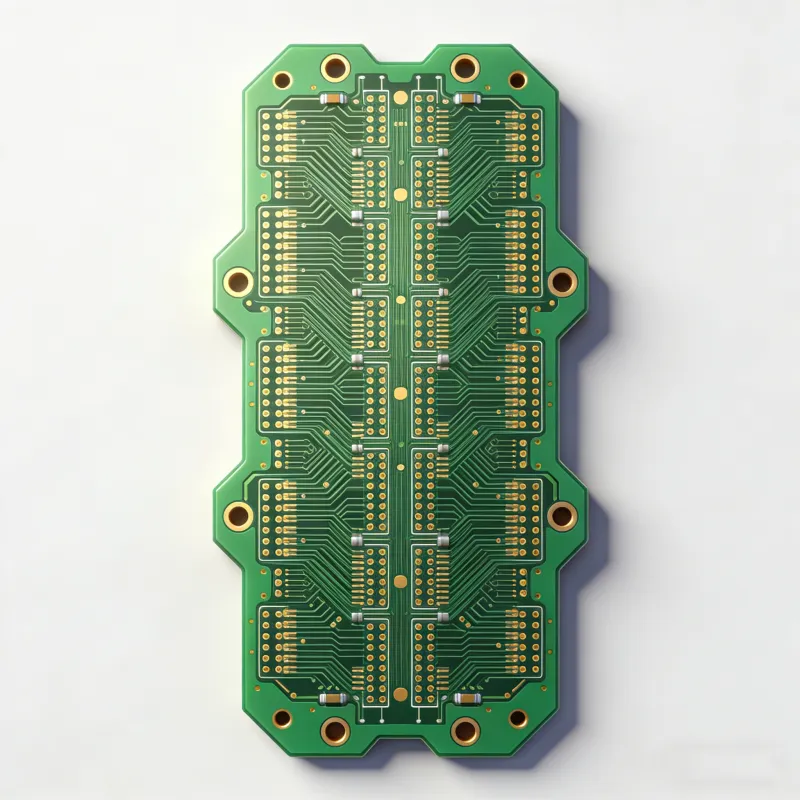
In high-frequency designs like 5G base stations and RF modules, signal integrity isn’t just a nice-to-have—it’s the foundation of performance. A single mismatch can cause signal loss, crosstalk, or even system failure under real-world conditions. That’s why understanding impedance control—from material selection to manufacturing tolerance—is critical for engineers designing next-gen telecom hardware.
A leading telecom OEM faced repeated yield issues during production of their 5G mmWave module. Initial simulations showed acceptable impedance profiles, but actual board measurements revealed inconsistencies—especially near BGA pads where trace widths dropped below 3 mils. After analyzing the stack-up and materials used (ISOLA 370HR), we identified two root causes: inconsistent copper thickness (±10%) and lack of tight control over prepreg resin flow during lamination.
We redesigned using MENTRON6—a low-loss, high-Tg laminate with consistent Dk (3.6 ± 0.1) across frequency bands—and implemented tighter tolerances: ±0.5 mil for line width and ±2% for dielectric thickness. These changes reduced impedance variation from ±15% to within ±3%, significantly improving return loss (< -20 dB) and reducing EMI susceptibility by over 40% in field tests.

Even with perfect design tools, poor fabrication execution leads to failure. For example, a 20-mil BGA pitch requires precise via placement and minimal pad ring deviation. In one project, AOI inspection caught 12% of boards with microvia misalignment due to tool wear—not design error. This highlights the need for continuous process validation through simulation + automated optical inspection (AOI).
Our team recommends setting up a closed-loop verification system: simulate → prototype → measure → refine. Use tools like SIwave or Ansys HFSS for pre-layout analysis, then validate with TDR measurements post-production. Don’t skip the step—many engineers assume “close enough” is good enough, but in 5G, it’s not.

Here are three mistakes we see most often:
If you're working on high-reliability PCBs for 5G infrastructure, aerospace, or industrial IoT, don’t leave impedance to chance. Our engineering team has helped over 50 clients achieve consistent, measurable results in complex multi-layer systems.
Explore Our High-Reliability PCB Solutions 247
|
247
|
 FPC high-density routing
flexible circuit board design
trace spacing control
EMI shielding in FPC
flexible PCB manufacturing
142
|
high-speed multilayer PCB
impedance control technology
telecom high-frequency PCB
5G communication PCB
signal integrity
459
|
Multilayer FPC Via Design
FPC Bend Area Stress
Flexible Circuit Design
High-Density FPC Routing
FPC Reliability Enhancement
317
|
high-density FPC routing
flexible PCB design
EMI optimization
medical FPC
consumer electronics FPC
259
|
Impedance control
High-frequency PCB
5G base station PCB
Signal integrity
High-speed multilayer PCB
FPC high-density routing
flexible circuit board design
trace spacing control
EMI shielding in FPC
flexible PCB manufacturing
142
|
high-speed multilayer PCB
impedance control technology
telecom high-frequency PCB
5G communication PCB
signal integrity
459
|
Multilayer FPC Via Design
FPC Bend Area Stress
Flexible Circuit Design
High-Density FPC Routing
FPC Reliability Enhancement
317
|
high-density FPC routing
flexible PCB design
EMI optimization
medical FPC
consumer electronics FPC
259
|
Impedance control
High-frequency PCB
5G base station PCB
Signal integrity
High-speed multilayer PCB








-1.png?x-oss-process=image/resize,m_fill,h_800,w_800/format,webp)
-L4-4.png?x-oss-process=image/resize,m_fill,h_800,w_800/format,webp)
-4.png?x-oss-process=image/resize,m_fill,h_800,w_800/format,webp)